
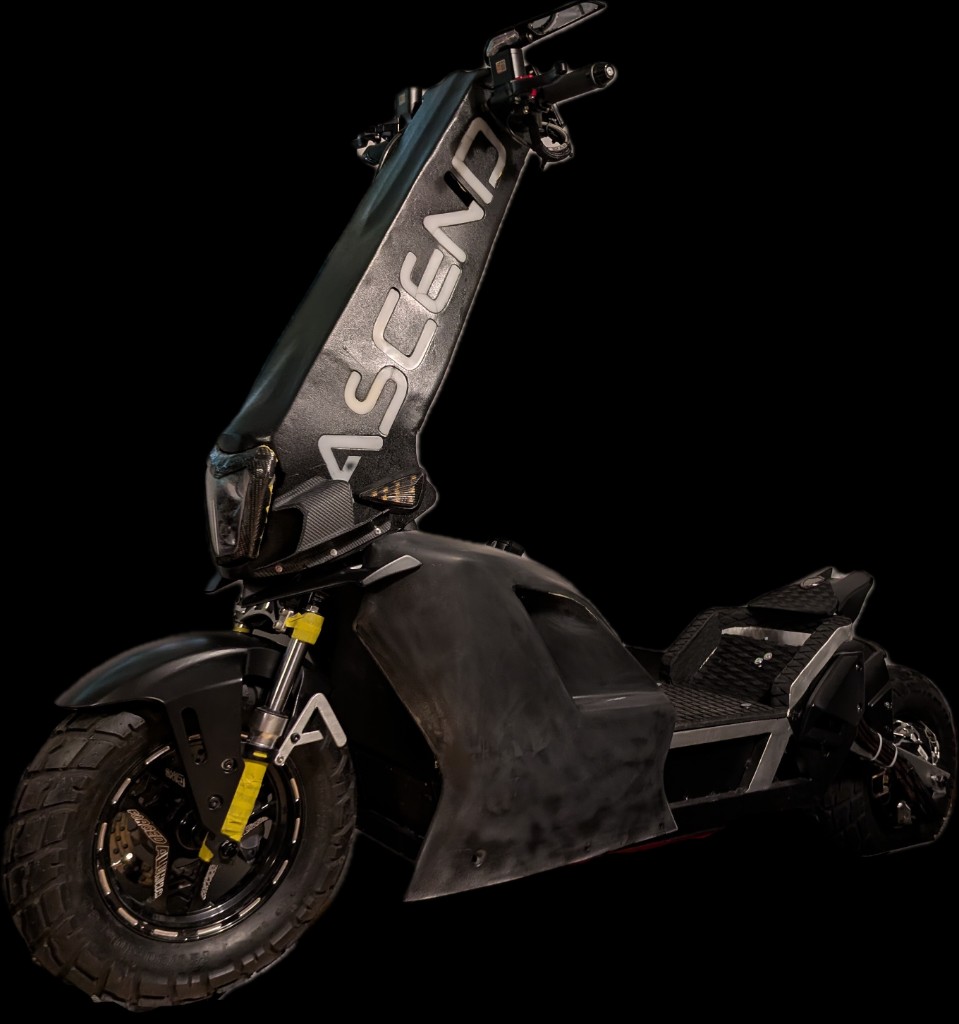
Ascend Mobility · Confidential · Seed 2026
Freedom is spelled GUARDIAN.
A vehicle engineered to survive the road, and a system that governs the rider on it.
The problem
149,100Americans went to an emergency room after a micromobility crash last year. Four times the 2017 number.
U.S. Consumer Product Safety Commission, 2017–2024
Who is getting hurt
36%of those injured are children 14 and under. They are 18% of the population.
U.S. Consumer Product Safety Commission, 2017–2022
The cost
533people have died since 2017. Twenty-five of them were children.
U.S. Consumer Product Safety Commission, 2017–2024 · reporting still incomplete
Why it keeps happening
Three failures. Nobody owns all three.
- Underbuilt hardware Toy brakes, eight-inch wheels, unprotected packs — never engineered for traffic.
- Ungoverned behavior Helmet and slow-zone rules exist on paper, and nowhere inside the vehicle.
- Zero accountability Banned by one operator, riding a competitor's vehicle the same afternoon.
Hardware companies ignore behavior. Software companies cannot touch the vehicle.
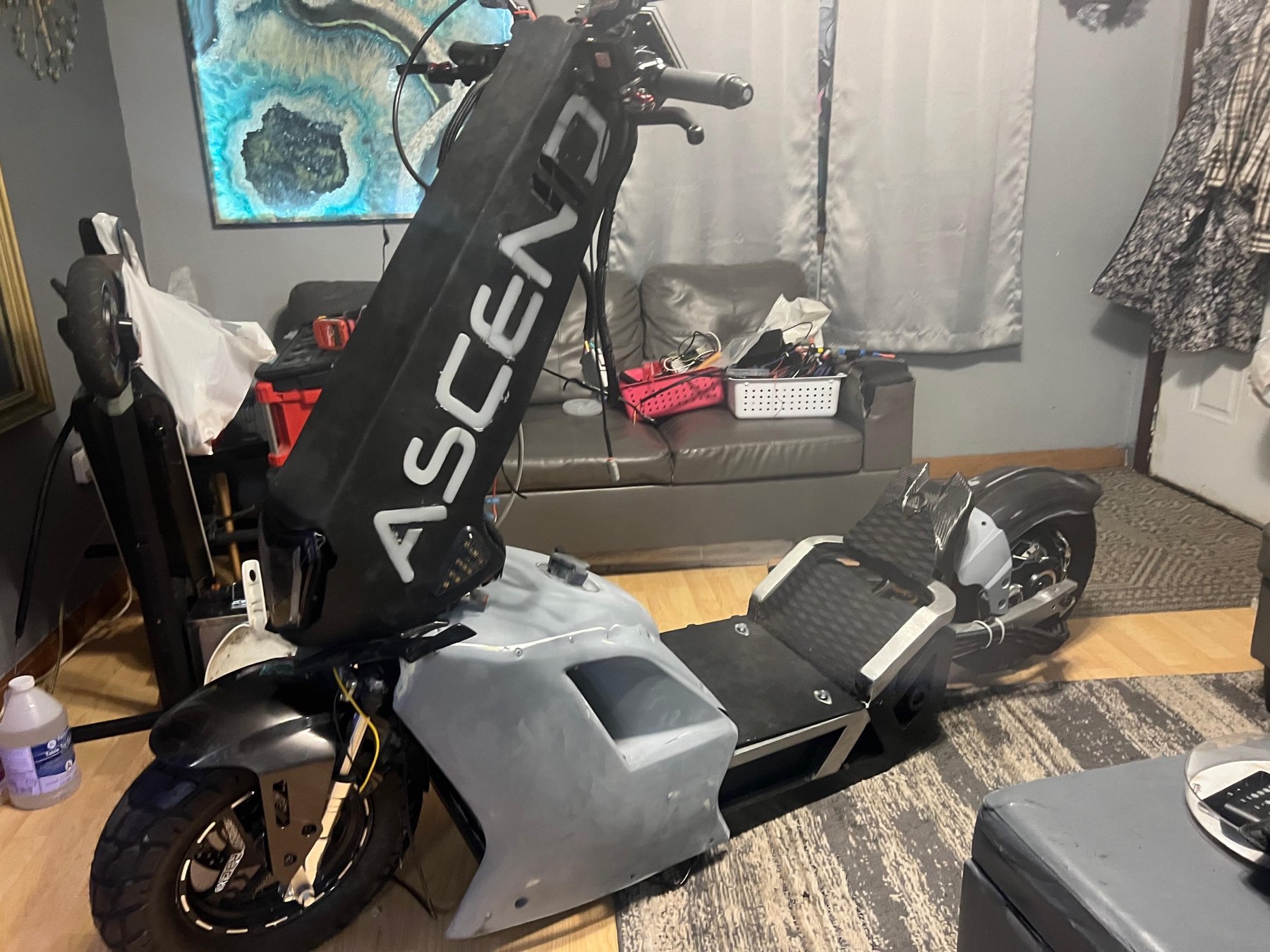
Layer 1 · The machine
So we built it ourselves.
Thirteen months from first drawings to road-legal. It started in a living room, not a lab.
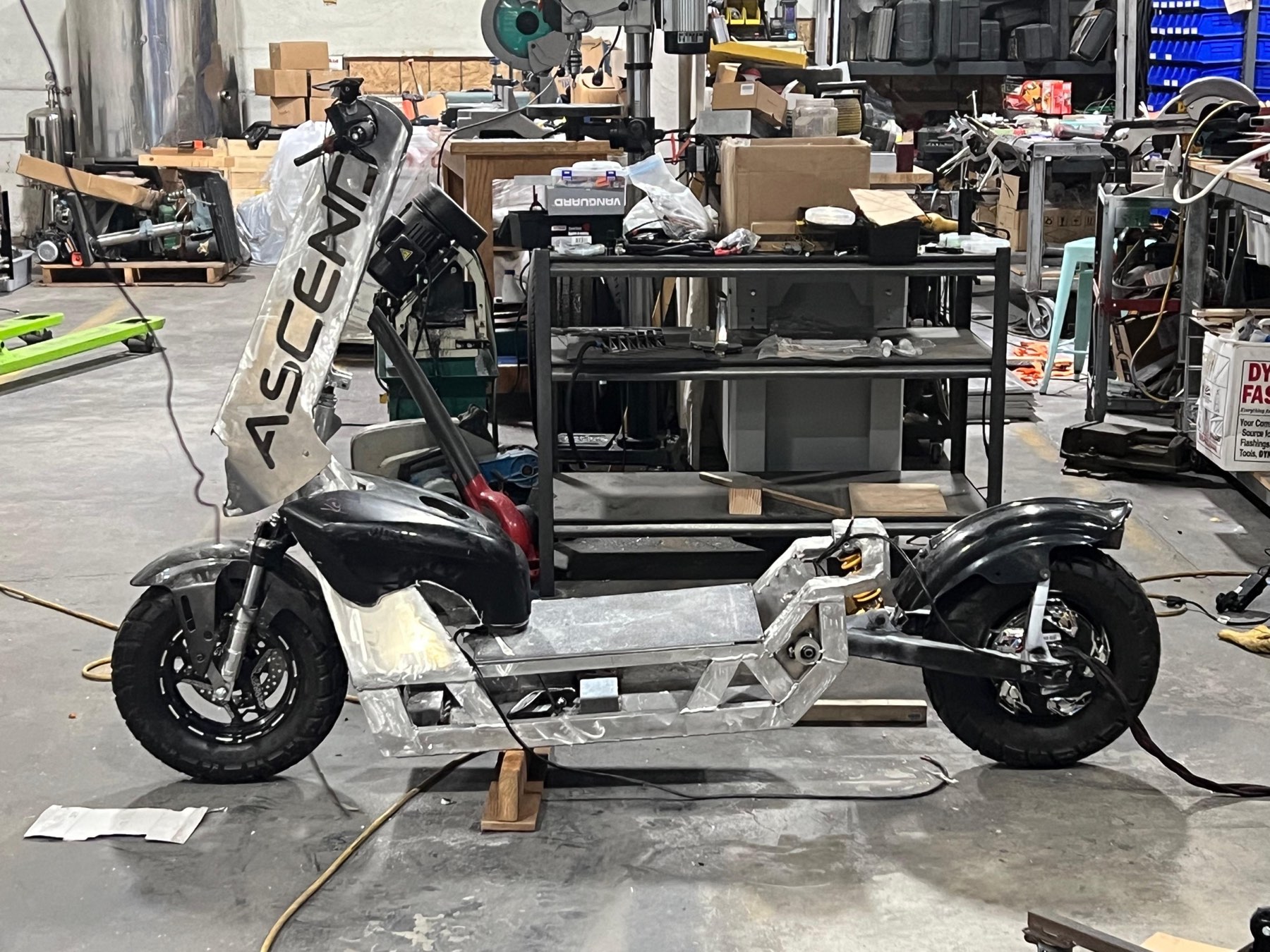
Engineering
Not a deck with a motor.
Welded aluminum chassis. Motorcycle-class tires and suspension. Four-piston 220 mm hydraulics.
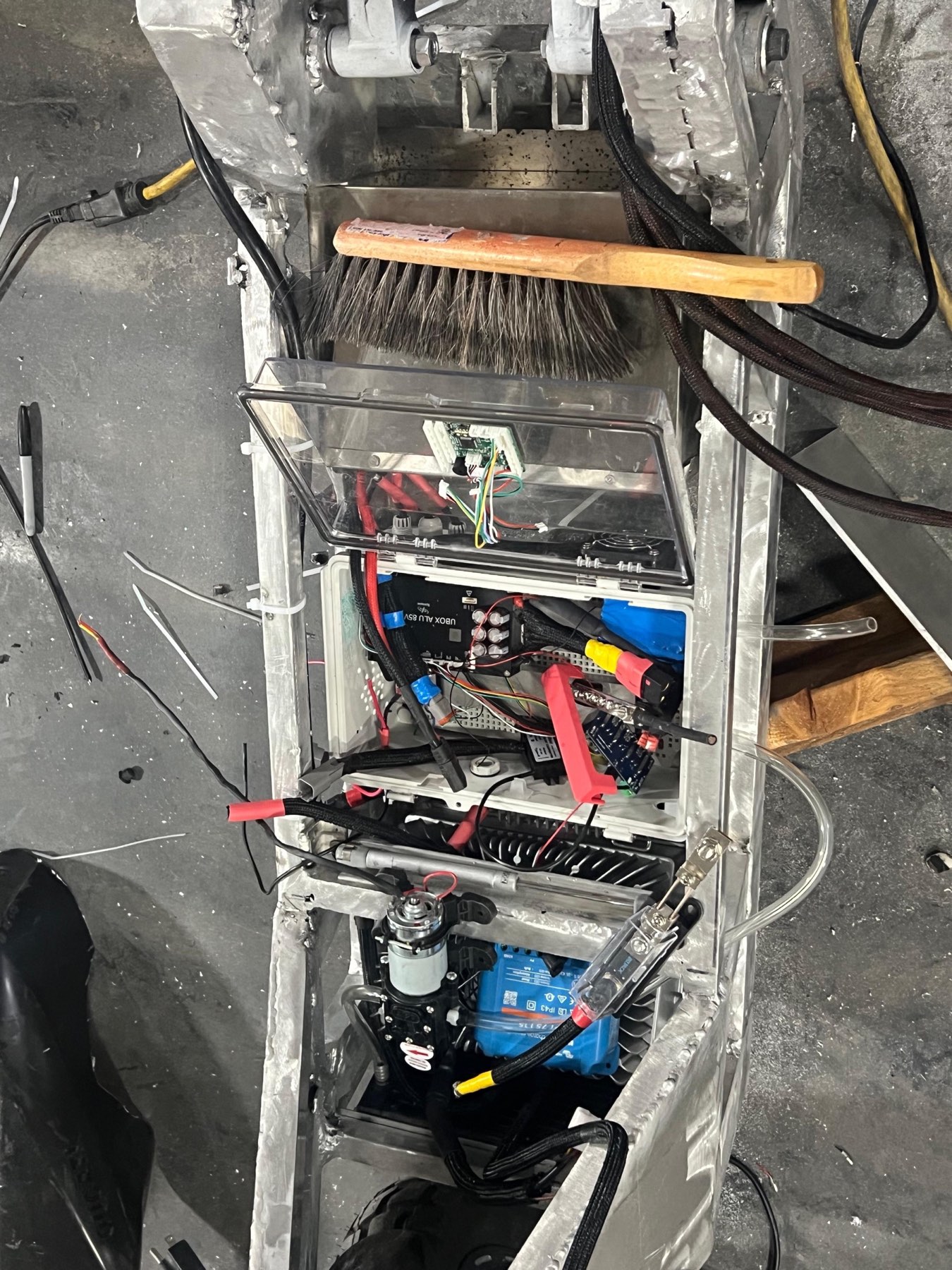
Safety by construction
Six layers between a battery and a fire.
Cell monitoring, thermal cutoff, isolation, fusing, sealed enclosure, automotive-grade controller.
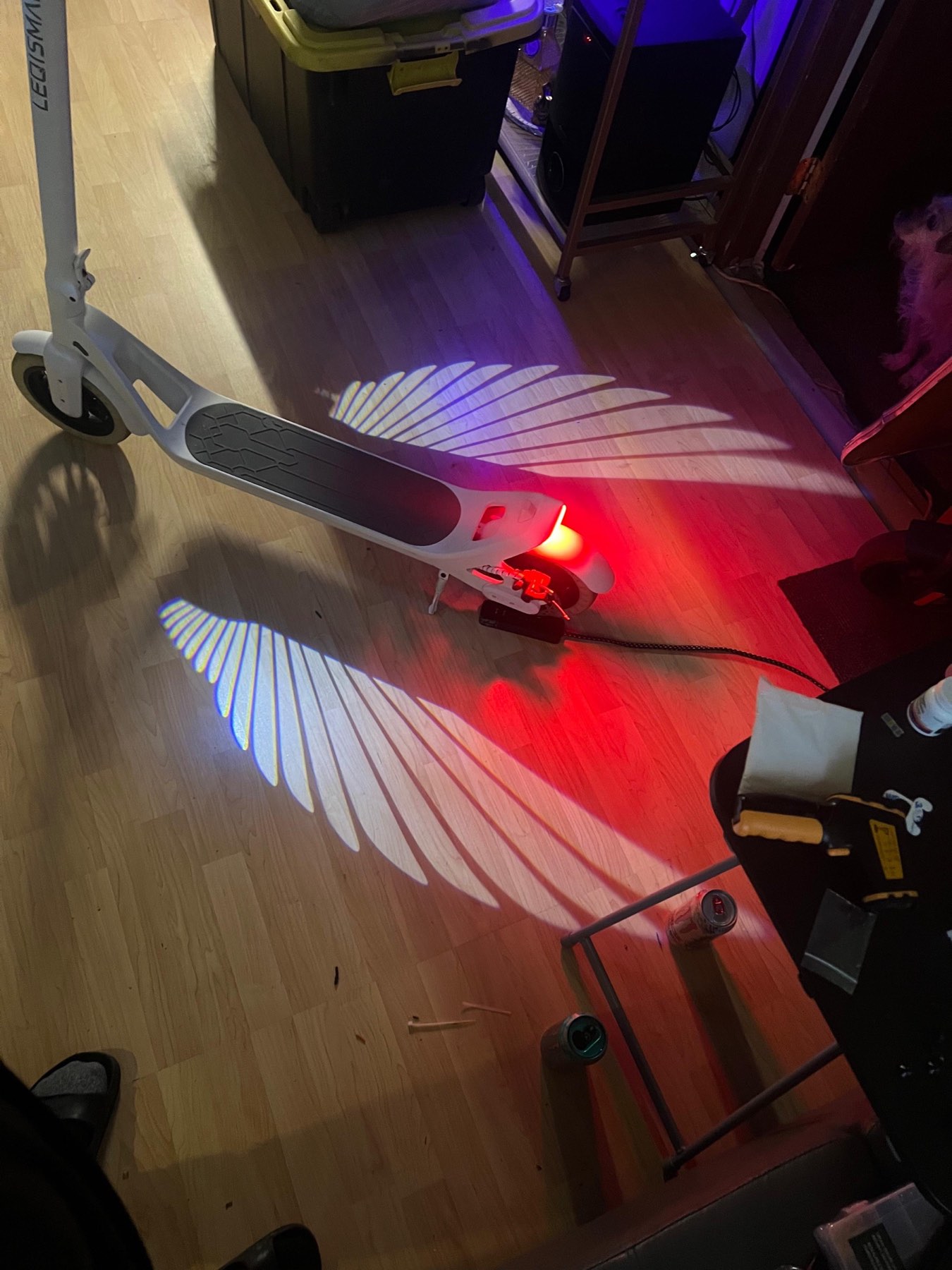
Visibility
Seen before it matters.
140 of 206 e-scooter deaths involved a motor vehicle. Being visible is a safety system, not a styling choice.
Layer 2 · Guardian OS™
Hardware survives the crash. Guardian prevents it.
Guardian does not file a report after an unsafe ride. It governs the vehicle during one — scoring the rider at the edge and changing what the machine will do.
The mechanism
A new rider does not start at 25 mph.
- 8Minimum
- 12Limited
- 20Standard
- 25Full
Speed is earned through clean rides and re-evaluated on every trip.
The network effect
Banned on one network. Banned on all of them.
The Cross-Operator Accountability Passport makes trust portable between fleets, the way a credit score travels between lenders. Cities see one rider record instead of four partial ones.
Business model
Sell the machine. Then price the trust.
- Hardware today $5,500–$12,999 per unit, 55–82% gross margin by volume.
- Guardian SaaS Per-vehicle subscription plus fleet-admin seats. Modeled, not yet contracted.
- Insurance participation Underwriting from governed, replayable evidence. The long game.
The ask
$1.25M seed.
- 40%Production tooling and supply chain
- 20%UL and DOT certification path
- 40%Guardian fleet beta, city pilots, sales
18 to 22 months of runway to make the safety case provable at scale.
End of the spoken deck
Appendix
Every claim above, with the federal data, the engineering detail, and the numbers behind the model.
The problem
Micromobility injuries have quadrupled in seven years.
This is not a projection or an industry estimate. It is the federal injury surveillance record, drawn from a nationally representative sample of U.S. hospitals.
- 698,500 Emergency-department visits for all micromobility products, 2017–2024. CPSC, 2017–2024
- 149,100 ER visits in 2024 alone — up from 37,300 in 2017. A statistically significant fourfold rise. CPSC, 2017–2024
- 533 Reported deaths: 310 e-bike, 206 e-scooter, 17 self-balancing. Reporting is still incomplete. CPSC, 2017–2024
- 79,300 E-scooter ER visits in 2024 — more than the category's entire 2017 and 2018 totals combined. CPSC, 2017–2024
Rental and shared e-scooters accounted for 35% of the 2024 e-scooter injury estimate — the exact fleet segment Guardian OS governs.
- All figures: U.S. Consumer Product Safety Commission, Micromobility Products-Related Deaths, Injuries, and Hazard Patterns, 2017–2024. Injury counts are NEISS national estimates from a representative hospital sample; fatality reporting for 2023–2024 remains ongoing and incomplete.
Who is getting hurt
Children are injured at twice their share of the population.
- 36% Of micromobility injuries were children 14 and under — double their 18% share of the U.S. population. CPSC, 2017–2022
- 25 Children under 15 killed: 20 aged 5–14, and 5 under the age of five. CPSC, 2017–2024
- 3.5× Rise in pediatric ER visits over six years. Of 1,466 children, 216 were hospitalized, 9 needed rehabilitation, 3 died. Median age: 14. Pediatr Emerg Care, 2024
- 18% Of injured e-scooter riders were wearing a helmet. Fractures are the most common injury; head and neck among the most common areas. CPSC, 2024 special study
“Current personal and road safety regulations are… inadequate in preventing these injuries, highlighting an urgent need for revision and stricter enforcement.”
Pediatric Emergency Care, October 2024
Enforcement is the operative word. A regulation a vehicle cannot read is a regulation that does not exist at the moment it matters.
Why it keeps happening
Three failures, and nobody owns all three.
-
1 · Underbuilt hardware
Toy-grade brakes, eight-inch wheels, unprotected battery packs. 140 of 206 e-scooter deaths involved a collision with a motor vehicle. The hardware was never engineered to be in traffic in the first place.
-
2 · Ungoverned behavior
32% of e-scooter injuries happen on paved sidewalks. 32% of injured riders were carrying something in their hands. Helmet and slow-zone rules exist on paper, and nowhere inside the vehicle.
-
3 · Zero accountability
Every operator keeps its own siloed trip log. A rider suspended by one network unlocks a competitor's vehicle the same afternoon, carrying none of their history with them.
Hardware companies ignore behavior. Software companies cannot touch the vehicle. We ship both, on one control spine.
- Injury and fatality figures: CPSC, 2017–2024 report and 2024 e-scooter special study.
The thesis
One company. Three layers. One control spine.
Ascend Mobility is not a scooter with an app bolted on after the fact. Hardware, vehicle control, and connected governance are a single stack, which is the only way a rule written by a city can become a physical limit on a wheel.
-
Layer 1 · Hardware
Scootmoto™ — survive the road
Motorcycle-class braking and rubber, six-layer battery protection, AutoStand, rider-presence interlocks, vehicle-grade lighting. The physical differences a rider feels on day one.
-
Layer 2 · VCU
NXP S32K312 — the control spine
An automotive-grade vehicle control unit coordinates drive, charging, AutoStand, thermal logic, and safety interlocks across every trim. This is the part that makes governance enforceable: Guardian does not send a notification, it sends a command.
-
Layer 3 · Guardian OS™
Guardian OS™ — prevent the crash
Behavioral rider scoring, trust-tier speed governance, geofence enforcement, replayable incident evidence, and city and insurer reporting — recurring revenue on telemetry the VCU already collects.
The hardware survives the crash. Guardian prevents it. The passport makes sure it does not happen twice.
Layer 1 · The machine
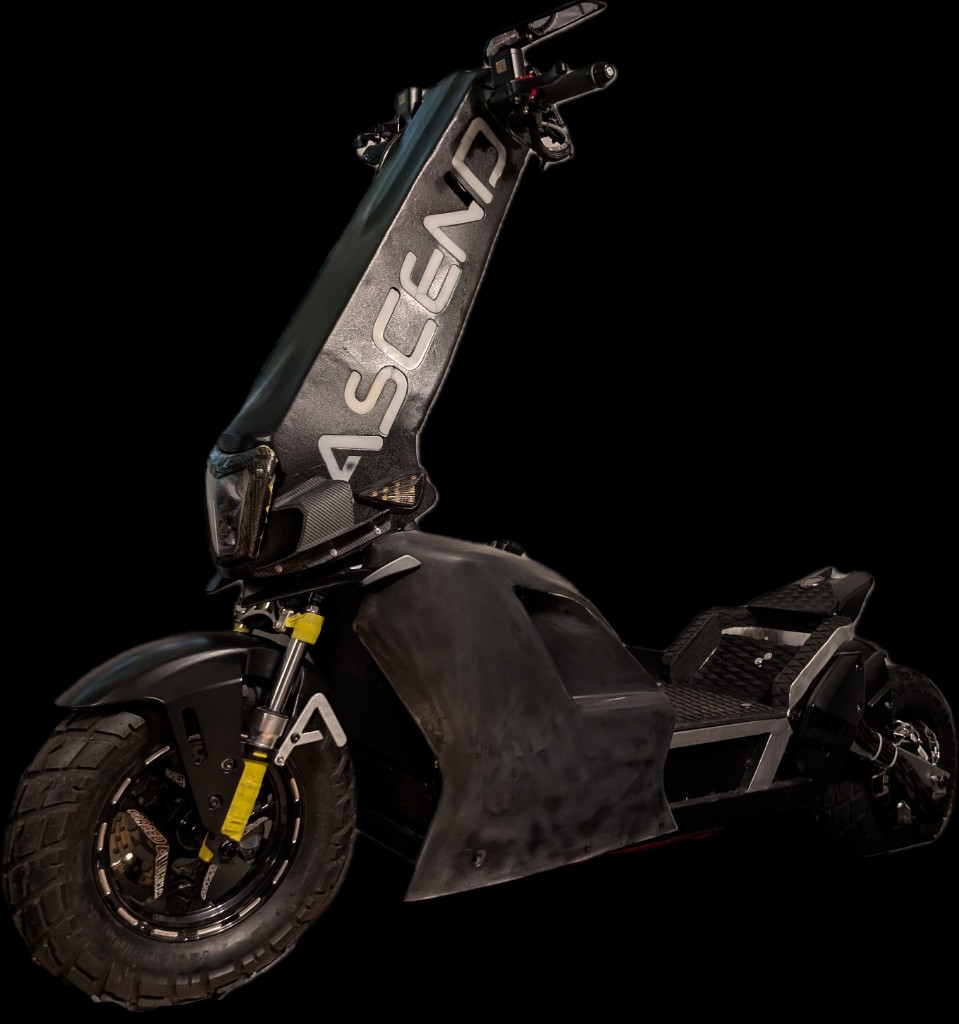
Thirteen months from first drawings to road-legal.
A completed, street-legal, rideable vehicle exists today. It began as a parent's decision to build something he would trust beside his own son in traffic.
-
01 — Stopping
220 mm four-piston hydraulics
Four-piston calipers on 220 mm rotors plus VESC-integrated regenerative deceleration, sized for heat capacity and repeat-stop consistency rather than a single brochure number.
-
02 — Stance
Motorcycle-class rubber
DOT-rated 120/90-10 tires, optional 12-inch forged wheels, NCY front hardware, and Öhlins TTX m.2 rear on the Founder's Edition. Broken pavement stops being a threat.
-
03 — Battery
Six-layer protection
Gas sensing, CANbus BMS integration, thermal control, insulation, fuse isolation, and automatic suppression. Redundant architecture, not a single-point claim.
-
04 — Trust
Rider-presence and AutoStand
Throttle lockout until the deck senses a rider. AutoStand deploys in under 0.25 s on dismount. Vehicle-grade lighting and an automotive-class VCU behind both.
Founder's Edition reference build: 4,500 W peak and 57 mph are stated Target figures under defined conditions, not guarantees for every trim or build state. Range remains unpublished until a defined test route is complete. Full detail in the technical specification and safety engineering brief.
Countermeasures · Hardware
Every number in the federal data has a part number.
-
140 of 206 E-scooter deaths involved a collision with a car, SUV, bus, or truck — the leading cause by a wide margin.→Scootmoto answer 220 mm four-piston hydraulics with regen, DOT motorcycle-class tires, real suspension, and vehicle-grade lighting — a machine built to be seen in traffic and to stop inside it.
-
20% Of injured riders reported that visibility problems contributed to the crash; it was dark or hard to see.→Scootmoto answer Vehicle-grade lighting and signalling designed to automotive conventions rather than a single deck-mounted LED. See visibility and signals.
-
Battery fires Driving building bans, insurance refusal, and the fastest-growing source of category risk for landlords and carriers.→Scootmoto answer Six-layer protection — gas sensing, CANbus BMS, thermal control, insulation, fuse isolation, automatic suppression — on a UL 2271 / 2272 certification path.
-
Step-off falls Unattended throttle and unsupported parking turn a stopped scooter into a moving hazard, most often around children.→Scootmoto answer Rider-presence throttle lockout and AutoStand stability assist, deploying in under 0.25 s on dismount with negligible standby draw.
- Left column: CPSC, 2017–2024 report and 2024 e-scooter special study. Right column: Scootmoto prototype-validated hardware; certification items are stated targets, not completed certifications.
Layer 3 · How Guardian works
Guardian does not report unsafe riding. It intervenes in motion.
One operating loop connects rider behavior to real-time vehicle governance and audit-grade evidence. This is what turns a scooter from a passive asset into an actively governed transportation node.
-
01 — Sense
Fused IMU and GPS track at roughly 10 Hz class cadence, with geofence boundary crossings streamed live.
-
02 — Score
Speed and sidewalk-risk events tagged to the rider session at sub-second evaluation cadence.
-
03 — Govern
Dynamic speed caps and zone rules pushed to the vehicle control path as governed commands — not app notifications.
-
04 — Prove
A signed event chain and replay bundle for every intervention, exportable for audit.
-
05 — Report
Operator console plus city and insurer-ready accountability artifacts, aligned to MDS 2.0 and GBFS feeds.
Guardian carries dedicated violation classes for the events that hurt children specifically: school-zone speeding, sidewalk riding, mandatory-helmet-zone entry, restricted-park entry, phone handling while moving, and ADA curb-ramp obstruction.
Countermeasures · Behavior
The rules already exist. Guardian makes them physical.
-
32% Of e-scooter injuries occur on paved sidewalks — where children, strollers, and wheelchairs are.→Guardian answer A dedicated sidewalk-riding violation class, geofenced 10 mph caps with yield enforcement, and hard no-ride polygons in downtown cores. Breach duration is logged to the second.
-
18% Helmet use among injured e-scooter riders, against head and neck ranking among the most-injured areas.→Guardian answer Mandatory-helmet-zone detection, helmet-confidence threshold flags, and a required education module on first unlock — mapped per jurisdiction, including under-16 and under-18 ordinance patterns.
-
School zones The one place where child exposure and rider speed overlap on a fixed, predictable daily schedule.→Guardian answer Active-hours school-zone governance with its own violation class, plus construction-zone and restricted-park equivalents. The cap applies during school hours automatically, without asking the rider.
-
32% Of injured e-scooter riders were carrying or holding something while riding — one hand, at speed, in traffic.→Guardian answer Phone-handling-while-moving detection with screen-attention duration, hard-braking cluster analysis, and progressive throttle limiting on approach to intersections.
- Left column: CPSC 2024 e-scooter special study. Right column: violation classes and governance controls implemented in the Guardian OS Wenatchee demonstration workspace; ordinance packs shown for multiple U.S. cities.
The mechanism
A new rider does not start with 25 mph.
Children are hurt at twice their population share partly because every rider gets identical capability from the first second of the first ride. Guardian makes speed an earned privilege, re-evaluated at the edge on every trip.
- 8 mph Minimum Repeat violations. All premium features locked, photo verification mandatory at trip end.
- 12 mph Limited Recent flags on record. Standard speed locked until a run of clean rides is completed.
- 20 mph Standard Good standing. Premium speed remains locked until five consecutive clean rides.
- 25 mph Full Earned. Full speed access and premium features, maintained by continued clean riding.
Freedom is earned through accountability, not removed through blanket restriction.
The reason cities reopen programs instead of banning themThe network effect
A rider banned on one network cannot hide on the next.
The Cross-Operator Accountability Passport moves trust tiers, violation history, and remediation out of any single operator's walled garden. Behavior becomes portable the way a credit score travels between lenders.
-
Cities see everything
Rider conduct across every participating network, not a stack of siloed monthly PDFs from competing operators. Repeat offenders surface as one record instead of four partial ones.
-
Good riders are rewarded everywhere
Earned trust carries between fleets, so responsible riders stop being penalized by the worst behavior in the category.
-
Data that compounds
Every intervention, geofence, route condition, and outcome deepens a behavioral and policy dataset that siloed trip logs cannot replicate.
-
Liquidity per city
Each additional city or carrier that honors the passport increases its value to every other participant. Competitors remain trip logs.
Trust-passport portability is a platform extension on the roadmap, not a live feature of the current Wenatchee demonstration. Roadmap
Why it gets adopted
One system, four stakeholders who normally fight.
-
Operators
Protect margin and utilization with rider-specific governance instead of blunt fleet-wide restrictions. At IPO, Bird disclosed that vehicle and insurance-related costs consumed the majority of rider revenue — structural loss, before a single fine.
-
Cities
Enforce policy with visible compliance, attributable controls, and proof that programs stay inside their intent. Agencies increasingly expect open trip feeds and spatial compliance as a permit condition, not a PDF afterward.
-
Insurers
Underwrite from governed, replayable evidence instead of category-level assumptions. Rising collision and liability pressure is already reshaping pricing and appetite in reported motor markets.
-
Riders
Earn access through responsible riding instead of living under the same ceiling as the worst rider in the city.
Guardian works because it aligns incentives that are usually in conflict.
- Operator cost structure: Bird Global Form S-1, SEC, 2021. Municipal oversight posture: NACTO shared micromobility program guidance. Insurance-market pressure: UK motor-market trade reporting on e-scooter collision and liability exposure, 2023 — directional context for carrier appetite, not a claim about any specific carrier's book.
Proof
What exists today versus what production requires.
Investors deserve a clean line between validated hardware and production intent. This is that line.
| System | Prototype validated | Production target |
|---|---|---|
| Safety stack | Six-layer BMS, rider-presence deck sensing, liquid cooling loop, four-piston hydraulics | UL 2271 / 2272 certification path, documented thermal test matrix |
| AutoStand | Deploy and retract under 0.25 s, automatic on dismount, under 1 V standby draw across ~7 days | Crash-trigger deploy, fleet telemetry hooks, production enclosure |
| VCU (NXP S32K312) | Central orchestration of drive, charge, AutoStand, and safety interlocks on the Founder's build | Secure boot, OTA update workflow, trim-specific feature flags |
| ChargeAnywhere™ | 3.3 kW onboard charger and retractable 120 V cord tested on road builds | J1772 / Level 2 input, solar assist on Founder's Edition, UL-listed charging path |
| Guardian OS™ | VCU telemetry logging and GPS/IMU capture on prototype; Wenatchee console with trust-tier scoring and geofence governance | Per-unit and per-fleet-seat SaaS, city and insurer export workflows, contracted pilots |
Wenatchee Valley pilot — the 72-day ban-to-permit template. Program reset and data charter with city mobility lead and counsel → geofence parity against authoritative GIS slow streets, corrals, and ADA buffers → council-ready compliance narrative with response-time SLAs and insurer-facing corroboration → public read-only municipal view → permit-ready documentation package. Improvement figures cited from this pilot (sidewalk-violation reduction, accountability-score delta, operator compliance rate) are outputs of an internal model on a demonstration fleet. Modeled
Market
The wedge nobody is building into.
| Segment | Price | What it is | Why it fails the buyer |
|---|---|---|---|
| Toy-grade | $500 – $4,000 | Commodity decks and lifestyle brands; Super73 tops out near $4K | Not built for motorcycle-class safety, charging flexibility, or fleet durability |
| Our wedge | $5,500 – $12,999 | Vehicle-grade systems, ChargeAnywhere, governed by Guardian | Insurable and maintainable without full-motorcycle complexity |
| Full e-motorcycle | $9,000+ | Zero and peers; a genuine vehicle | Different license, insurance, and rider profile than urban commuters want |
-
Hardware market
US e-moped and premium e-scooter segment, current year: US market size + source. We cite US-only, current-year sizing rather than unsourced global TAM.
-
Software market
Third-party analysts size micromobility fleet-management software near USD 1.4B globally in 2024. Directional third-party scope, not Guardian revenue. Directional
-
Who buys
Urban performance commuters, safety-conscious family buyers, fleet and campus operators, and delivery riders who need insurable, maintainable hardware.
Business model
Start with hardware margin. Expand into pricing trust.
| Revenue line | Model | Economics | Timing |
|---|---|---|---|
| Unit sales | Direct-to-consumer plus B2B fleet | $5,500 – $12,999 per unit at 55–82% gross margin by volume | Now |
| Guardian OS SaaS | Per-unit subscription plus per fleet-admin seat | Pilot annual contracts in the mid-to-high five figures for a ~30-vehicle fleet, stepping toward tens of dollars per vehicle per month at scale Modeled | Alpha at seed close |
| Deployment and integration | Scoped SOWs: telemetry path, QA harness, cutover | Milestone billing alongside the SaaS envelope Modeled | Per pilot |
| Compliance services | Permit-ready reporting, MDS/GBFS handoffs, audit packs | Annual add-on packages; a fractional uplift on the core fleet fee Modeled | Year 2 |
| Insurance participation | Data and API access plus performance-linked economics | Contingent on carrier design partnerships; illustrative until programs harden Illustrative | Year 2–3 |
Guardian is what converts a one-time hardware transaction into recurring revenue on telemetry the vehicle already produces. Assumed attach: Year 1 attach rate of units sold, and fleet attach rate on B2B units.
Traction
At this stage, documented units beat vanity metrics.
Founder-led builds in Chelan and Wenatchee, Washington prove demand, production discipline, and unit economics before tooling scale.
| Signal | Current | Notes |
|---|---|---|
| Units shipped | units shipped | Founder-led production at a 3–5 per month run rate |
| Average selling price | ASP | Mix of standard tier ($5,500) and Founder's Edition ($12,999) |
| Returns and refunds | 0 | Zero returns to date; every shipped unit documented |
| Waitlist | waitlist signups | From the letsascend.life waitlist and direct outreach |
| LOIs and pilots | LOI / pilot count | Fleet, campus, and institutional conversations |
| Guardian pilot | Wenatchee | Live demonstration workspace on real city geometry; moving toward contracted pilot |
Highlighted cells are unfilled figures. The deck header shows a running count so this never ships with a blank in it.
Unit economics
Margin that works at 3 units a month and at 1,000 a year.
| Per unit | Standard tier | Founder's Edition |
|---|---|---|
| Retail price | $5,500 | $12,999 |
| Build cost, small scale | ~$2,500 | ~$4,500+ |
| Gross margin, small scale | ~55% | ~65%+ |
| Build cost at volume | ~$1,250 or less | ~$2,250 or less |
| Gross margin at volume | ~77%+ | ~82%+ |
- ~$650K Hardware revenue at 100 annual units, ~$6,500 blended ASP. Roughly $500K gross profit.
- ~$3.1M At 500 annual units, ~$6,200 blended ASP. Roughly $2.4M gross profit.
- ~$5.9M At 1,000 annual units, ~$5,900 blended ASP. Roughly $4.5M gross profit.
Projections assume volume gross margins on hardware only. Guardian SaaS, compliance services, and fleet contracts are upside and are not included above. Projected
Team
Compliance discipline is the founder's actual background.
Two decades building regulated physical products — CPG manufacturing, compliance-heavy categories, and the documentation practice that keeps products on shelves and out of recall headlines. That is not adjacent to safety-critical hardware. It is the playbook for it.
“I spent 20 years scaling manufacturing in regulated markets. Micromobility has the same problems. I'm applying those playbooks here.”
Ryyan Truesdell, Founder and CEO-
Why this founder, this problem
The first prototype was a parent's safety decision before it was a company: build something he would trust beside his own son on real streets. It proved technical feasibility and demand for the category between toy scooters and motorcycles.
-
Current team and gaps this round closes
Founder-led builds de-risk assembly, warranty, and field support today. This round funds key hires and contractors across electrical, firmware, and deployment engineering, plus advisors.
Risks and honest scope
What we do not claim.
-
Certification timelines can slip
UL, DOT, and local compliance schedules can delay hardware launch and fleet sales. Mitigation: ~20% of the raise reserved for compliance, third-party test lab engaged early, and a feature set designed to existing standards rather than bespoke exemptions.
-
Supply chain at low volume
Cells, controllers, and custom enclosures carry lead-time volatility. Mitigation: dual-sourcing on critical paths, a QS-class motor supplier with a service network, and modular architecture that limits single-point BOM failure.
-
Hardware execution risk
First scaled batches carry rework, warranty, and field-support exposure software startups never face. Mitigation: founder-led builds today, every shipped unit documented, conservative small-scale margin assumptions.
-
Market and insurance timing
Premium micromobility is cyclical and sensitive to macro and insurance headwinds. Mitigation: wedge positioning avoids both the commodity race and full-motorcycle compliance; fleet and campus channels diversify DTC dependence.
Our stated limits. No crash-test claims and no implied government endorsement. No homologation promise without documentation attached. Performance figures are targets under defined conditions, not guarantees. Pilot economics are modeled outputs on a demonstration fleet, not audited fleet performance. Range stays unpublished until a defined test route is complete. Liability remains with operators and riders per municipal permit; city views default to aggregates; DPAs precede production.
- Sources. U.S. Consumer Product Safety Commission, Micromobility Products-Related Deaths, Injuries, and Hazard Patterns, 2017–2024 (NEISS national estimates) — cpsc.gov. CPSC news release, E-Scooter and E-Bike Injuries Soar, 2024 (children 14 and under, 2017–2022) — cpsc.gov. The Incidence and Severity of Pediatric Injuries Sustained by Electric Bikes and Powered Scooters, Pediatric Emergency Care, October 2024 — PMID 39475107. Bird Global Form S-1, SEC, 2021 (per-ride cost structure). NACTO shared micromobility program guidance (municipal oversight posture). Micromobility fleet-management software sizing: third-party analyst snapshot, directional only.
The ask
$1.25M seed to make the safety case provable at scale.
This round unlocks full production tooling, supply-chain buffer, the certification path, a sales hire, fleet pilot execution, and the Guardian fleet beta — roughly 18 to 22 months of runway.
| Scenario | Amount | Runway | Milestone unlocked |
|---|---|---|---|
| Minimum viable | $500K | ~12–14 months | Tooling deposit, UL/DOT path, first scaled batch, Guardian alpha |
| Target round | $1.25M | ~18–22 months | Full tooling, 80–100 units per month, 1,000+ cumulative units, Guardian fleet beta and contracted city pilots |
| Full round | $2.5M | ~24–30 months | Multi-shift capacity, international prep, enterprise fleet contracts, Series A metrics |
- 40% Production tooling and supply chain
- 20% UL / DOT certification
- 20% Sales, marketing, fulfillment
- 10% Guardian OS development
- 10% Operations, legal, working capital
Data room, financial model, and diligence calendar on request: freedom@letsascend.life · East Wenatchee, WA · letsascend.life